For non-fiction lovers, here’s a terrific book!
Please note that I am now an Affiliate Marketer on Amazon. This means my book reviews will include a link to the book on Amazon. If you purchase the book using my link, I will earn a small commission. This is at no additional cost to you. More details here. Thank you for supporting my Book Blog in this manner.
*****
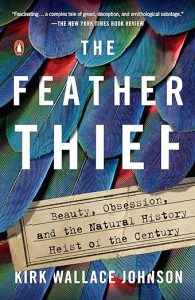
I will confess that it took me a while to get into this book, though I loved it once I did. I think my difficulty stemmed from the author’s need to introduce so many key players – four to be exact – at the start of his story. Here they are now. Get them under your belt so you can relax into this intriguing story of feather mania thru the centuries, a major feather heist in 2009, and the trial of the feather thief that may or may not have resulted in justice being served. You tell me what you think after reading the book.
It is in the prologue that we meet Edwin Rist, a twenty-year-old American student at the Royal Academy of Music in London. He is the feather thief, the fellow who pulled off a heist at the British Museum of Natural History in 2009. He stole 299 bird skins from the museum for the purpose of getting exotic feathers to create flies for fishing. We will come to learn a lot about fly tying as an art form – and about the obsessive world of the fly tiers who make them.
Then we get to chapter one where we learn about Alfred Russel Wallace, a famous naturalist born in 1823. Through his extensive research in the wild, he independently discovered the theory of natural selection. He even wrote to Darwin about it. But due to Wallace’s years out in the field, Darwin’s Origin of the Species was already in its third printing when he came back to civilization. Upon Wallace’s death in 1913, the British Museum housed the large collection of his specimens.
To protect this vast collection from Hitler’s bombs during World War II, curators secreted Wallace’s – and Darwin’s – bird skins to safe houses. Many went to a tiny museum in Tring, which became their permanent home. This brings us to the third key player – Lionel Walter Rothschild. A member of the famous Rothschild family, he had no interest in banking. Instead, he was an obsessive bird collector. The Tring Museum was built for him as a 21st birthday gift from his father. It was the Tring Museum – now a part of the British Museum of Natural History – from which Edwin Rist stole Alfred Russel Wallace’s birds.
The fourth key player in the book is the author himself. We meet him in the prologue as he is fly-fishing with a talkative private guide who tells him the story of the Tring Museum Heist. At that point, Rist had been arrested and had confessed. However, only 174 of the 299 birds stolen were found intact in Rist’s apartment. Where were the other birds? Kirk Wallace Johnson is intrigued by the story and becomes obsessed by the story. Ultimately, he spends five years trying to discover what happened to the lost birds of Tring.
The reason he goes down this particular rabbit hole is because he desperately needs a diversion in life. His previous job had been to coordinate the reconstruction of the Iraqi city of Fallujah for USAID, the U.S. Agency for International Development. After that, many of his Iraqi colleagues were hunted and killed by their own countrymen because they had “collaborated” with the United States. In droves, these refugees came to him for help. Thanks to all this stress, Kirk Wallace Johnson needed a new direction in life. Enter the world of feathers.
The author tells us about many things in his book:
- As part of the history of feathers we learn about the fashion industry in the 1800’s. “Before the Hermes bag or Louboutin heel, the ultimate status indicator was a dead bird.” At the start, exotic feathers adorned hats and by the end, entire birds were mounted on hats. (One of many sections at the end of the book shows photos of such hats!)
- We go to the trial of Edwin Rist and learn of the unique defense used – the Asperger’s Defense.
- And we come to empathize with Alfred Russel Wallace who had major losses to his specimen collection not just posthumously, but during his lifetime too.
In the end, there were two big takeaways from the book. First, it’s extremely difficult to figure out who-done-it-and-why in any criminal investigation even if you have an investigator working on it non-stop for five years! And second, there is a lot to know about feathers!
*****
Click here to learn more about The Feather Thief.

*****
If you like my writing, did you know I have four books in print? They are all available on my Etsy shop. My newest book, Love, Loss, and Moving On, is also available on Amazon. Please have a look and tell a friend!


Leave a Reply