Progeria, the Rapid Aging Disease
(NOTE: I am an affiliate marketer on Amazon. If you click one of my Amazon links and make ANY purchase there, I earn a small commission at no additional cost to you. Isn’t that cool? Thank you for supporting my writing in this manner. More details here.)
*****
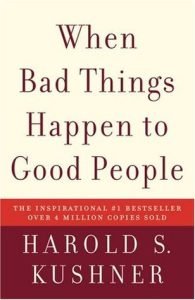
This book was first published in 1981. It went on to sell over four million copies and is still in print today. The backstory for the book is wrenching. Rabbi Harold S. Kushner’s son, Aaron, was born in 1963. The rabbi and his wife became concerned about him when he stopped gaining weight at the age of eight months and when his hair started falling out after his first birthday.
Ultimately, Aaron was diagnosed with a condition called progeria, also known as “rapid aging.” Doctors told the Kushners that “Aaron would never grow much beyond three feet in height, would have no hair on his head or body, would look like a little old man while he was still a child, and would die in his early teens.”
If this wasn’t horrible enough news, it was delivered to the family on the day their second child was born. More horrible news: Aaron died two days after he turned fourteen.
How does anyone survive and make sense of such an occurrence?
You will want to read the book to see what Rabbi Kusher has to say. I will not try to explain it in my own words since he makes his argument so eloquently, but I will tell you some of the concepts he mentions to show you the range of the book and then I will give you my favorite quotes from reading it.
Some concepts discussed in the book:
- Of course, Kushner dissects the Book of Job ultimately deciding that only two out of three things can be true in the tale: God is all-powerful and causes everything that happens in the world; God is just and fair so that good people prosper and the wicked are punished; Job is a good person. He tells us that all three cannot be true at the same time.
- He debunks Thornton Wilder’s explanation of bad things happening in the world. Wilder imagines a tapestry that is beautiful on the front side but has a hodgepodge of threads on the back, some long and some cut short, some smooth and others knotted.
- He addresses the Holocaust by quoting a survivor who starts by saying, “It never occurred to me to question God’s doings or lack of doings while I was an inmate of Auschwitz…”
And then, there were several things I will carry away from the book:
- The idea that God’s role in a tragedy is to be our helper. As Kushner says: “All the responses to tragedy which we have considered have at least one thing in common. They all assume that God is the cause of our suffering, and they try to understand why God would want us to suffer…There may be another approach. Maybe God does not cause our suffering. Maybe it happens for some reason other than the will of God. The psalmist writes, ‘I lift mine eyes to the hills; from where does my help come? My help comes from the Lord, maker of Heaven and earth.’ He does not say, ‘My pain comes from the Lord,’ or ‘my tragedy comes from the Lord.’ He says, ‘my help comes from the Lord’”.
- The importance of having a community to help us through life is addressed in this fashion, “One goes to a religious service, one recites the traditional prayers, not in order to find God (there are plenty of other places where He can be found), but to find a congregation.” He reiterates the point with a tale from storyteller Harry Golden: “When he was young, he once asked his father, ‘If you don’t believe in God, why do you go to synagogue so regularly?’ His father answered, ‘Jews go to synagogue for all kinds of reasons, my friend Garfinkle, who is Orthodox, goes to talk to God. I go to talk to Garfinkle’”.
- This all rolls together in Rabbi Kushner’s definition of an answered prayer. He says to a bereaved woman: “You didn’t get a miracle to avert a tragedy. But you discovered people around you, and God beside you, and strength within you to help you survive the tragedy. I offer that as an example of a prayer being answered.”
I can’t close without saying…
This thought-provoking book was written in memory of Aaron Zev Kushner 1963-1977.
And my review is written in memory of Rabbi Harold S. Kushner 1935-2023.
*****
Click here to learn more about When Bad Things Happen to Good People on Amazon.

*****
Click here to join the Book Lovers Club. I post about three dozen book reviews a year. If you would like to receive them as I write them, please join the Club.

*****
If you like my writing, I hope you will check out my new book, Chai on Life. It contains 36 slice-of-life stories ranging in topics from belly fat to Billy Joel. It is available wherever books are sold and on Amazon. There is even a companion journal for you to write the stories of your life.
Chai on Life is available in 3 formats: Hard Back, Kindle, and AudioBook.

*****
And one last thing! Amazon has named me an Influencer (!!!!) and invited me to open a Storefront. You will find lots of my favorite things there including fun gifts for people who love to read. Check it out!


Leave a Reply