Mental Snapshots of the Journey
People ask me about my recent trip to Poland and I don’t know what to say. After visiting four concentration camps and numerous mass graves, speechless doesn’t quite cover it. Jews were targeted and virtually wiped out in Poland for the simple fact that they were Jews. There are no words.
On my first trip to Poland ten years ago, my travel partner and I decided not to take photographs at Auschwitz. It was not a tourist attraction! It was a graveyard! For this trip, our tour leader, Lisa, told us that we need to take photos and that we need to show them far and wide. It is our obligation not only to bear witness to the slaughter but to make others aware of it too.
That’s such a silly word to use. Most people – except of course for the Holocaust deniers – are aware of the Holocaust. With this story, I hope to make that awareness more visceral. I will present mental snapshots of this journey starting with the most horrid so that readers will know they have seen the worst and hopefully will continue reading – and bearing witness.
The facts I present here come from Alan, our tour guide. He was born in Philadelphia and moved to Israel in 1989 after completing college. In subsequent years, he has earned a Masters in Jewish History and is currently working on a PhD in Holocaust and Genocide Studies. He has led Jewish Heritage tours to Poland for 25 years, and has known and gotten firsthand testimony from survivors.
One main lesson from Alan is this: Instead of saying that six million Jews died in the Holocaust, we need to say that six million Jews were murdered in the Holocaust.
The worst memory of the trip was a mass grave for children. Nazis did not want to waste bullets on babies. According to an eye witness report, babies had their heads smashed against a tree before they were thrown into the pit.
Here is my eye witness report of the rest of the top ten horrors for me.
Warsaw Jewish Cemetery – It is inside the area of the Warsaw Ghetto. It contains three mass graves for the 80,000 Jews who died from starvation, etc. while forced to live there.
There is also a memorial to the sewer system of the city. It is a metal grate with a Star of David on it so that visitors do not fall into the open hole. The sewer stunk to high heaven but it was actually a lifeline to the prisoners of the Ghetto. They could crawl through it to get beyond the locked Ghetto walls.
*****
Bialystok – In this city, 800 to 1000 Jews were locked inside the Great Synagogue which was then set on fire. Among those murdered was Lisa’s great-grandfather, David Sznajder (Schneider).
*****
Tykocin – We followed the footsteps of the 2100 Jews of the city as we walked into a beautiful wooded area. Trees! So many beautiful trees! They led to mass graves. All 2100 people were shot and fell into the pits that had been dug there to receive them.
*****
Treblinka – There was no “selection” at Treblinka. No one got a tattoo, a uniform, and a work detail. As part of Operation Reinhard, all who were sent there died in the gas chamber. The life span of the 900,000 Jews sent to Treblinka was 1-2 hours.
In the same manner that Jews were crammed into railway cars to bring them to the death camp, so were they crammed into the gas chambers. So many were killed at a time – up to two thousand – that they did not have room to fall to the floor. They died standing up and tangled together.
This was the place where the Jews of Warsaw were sent.
This is where my family was murdered.
*****
Majdanek – Whereas Treblinka was destroyed by the Nazis at the end of the war and only a memorial to the camp exists today, at Majdanek one can see the full camp. It’s horrific as one would expect. But more horrible to me is that just outside the gates of the camp is a residential area where people currently live. How dare they!
And while we’re on the topic, Majdanek was three kilometers from the city center of Lublin. That’s less than two miles. Don’t tell me they didn’t know what was going on within walking distance of their town. I am enraged!
And furthermore, it was not just this bad guy, Hitler, who created the Holocaust. It required a HUGE machine of sadistic sociopaths to carry out such a slaughter, not to mention all those who looked away.
*****
Yeshivat Chachmei in Lublin – This was the most famous Yeshiva (school) of Poland, if not the world. It is now a hotel. Similarly, the mikvah (ritual bathhouse) in Zamosc is now a night club. Why? There are virtually no Jews left in Poland.
*****
Izbice – This town had been 95% Jewish before the war. Now all Jews are gone. One needs to climb up into the hillside to see the old Jewish cemetery that was destroyed during the war. Large chunks of Jewish headstones are stacked up to create a wall. I guess that’s better than what we saw at Majdanek where fragments of broken tombstones were used as the foundation for roads built by prisoners.
*****
Belzec – I had never even heard of this camp! It is another Operation Reinhard Death Camp where 700,000 Jews were murdered. It was destroyed by the Nazis at the end of the war as they tried to conceal the evidence of their deeds. It is a museum and memorial now.
*****
Auschwitz – saving the most horrific for last, we spent our entire last day in Auschwitz I and II (aka Birkenau). We had already seen the Holocaust by bullets and the Holocaust by gas. Here we fully explored the Holocaust by being worked to death.
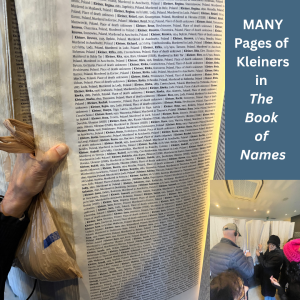
Auschwitz is the story of the rest of the Jews of Europe since most of the Jews of Poland had already been killed in other camps. It is appropriate therefore that Auschwitz houses a permanent exhibit called The Book of Names.
The book is 20,000 pages long and each page is poster-sized. In it, the names of those who were murdered in the Holocaust appear in English in alphabetical order. Date and place of birth are given as well as place of death if known. The book was created by Yad Vashem, the Holocaust Museum in Israel. It is their goal to document all Jews who were murdered in the Holocaust. Currently, the book holds over four million names.
These are the names of all of those nameless people in all of those mass graves.
And so I end where I started, with the mass grave for the children. In that area, many people leave gifts for the dead. Among them was a small yellow and black stuffed toy, very similar to one that my grandson, Josh, had the good fortune of loving because he had the good fortune of living.
Six million of my fellow Jews did not have that good fortune. I mourn them all.
*****
Thank you for reading this blog. It would mean the world to me if you would subscribe to my blog/newsletter. You will receive exactly 28 emails from me in a year’s time. They will include 4 reports for book lovers and 24 slice-of-life blogs. Thanks for considering this. Lorie


No words. Love you.
Love you back. I am grateful for life, you kids, and all the grandgirls and boys.
Thank you.
Oh Rocky, thank you for reading.
What can one say? It’s just so hard to even think about it. Thank you, Lorie for taking the time to do this. You needed to do this and we needed to read it.
I have a picture book withdrawn from Montgomery’s library after I left that I am going to get to Shana, probably through Lila. I have memories of reading it to the kids at Hannukah. When I read of your trip, I knew it needed to be in your family.
Hi Sharon, Thanks for validating this story. Can’t wait to see the book…
This is a lovely way to pay tribute to all those lost lives. I find it helpful to see some of the numbers broken down like this, as it’s hard to conceptualize 6 million people. Hearing about 900,000 killed this way and 700,000 killed this other way… it helps me wrap my mind around it a bit more, though obviously it’s hard to wrap my mind around it at all.
6 million is hard to imagine. That’s for sure. Kids in Tennessee had that problem when they studied the Holocaust and collected 6 million paper clips to see what it meant. Interesting project! Here’s a link if you are interested in reading about it: https://oneclipatatime.org/paper-clips-project/
It took a lot of courage to take this trip and, then, recount what you learned. Thank you for documenting such a difficult journey.
Thank you for reading it. I know that was tough too. But we all need to bear witness…
Thanks, Lori, for writing this. I have passed it on to some of my non-Jewish friends. We all need to know and remember, so nothing like this ever happens again.
Thanks so much, Cindy. Yes, pass the story on. By the way, I thought of you when I saw the sewer in the Warsaw Ghetto since we both read that same book. In it, those imprisoned in the Ghetto indeed made use of the sewers to get supplies.
Thank you Lorie for sharing your gut wrenching journey and witness of unthinkable acts of evil.
Today, tomorrow and always we must all speak out against injustices and hatred at specific groups of people.
Oh Nancy. Thanks. Unthinkable acts of evil – exactly!
Thank you for this reminder Lorie. I appreciate you.
Thanks so much, Kate. So nice to hear from you…