Dystopian Novel or Philosophical Treatise?
Please note that I am now an Affiliate Marketer on Amazon. This means my book reviews will include a link to the book on Amazon. If you purchase the book using my link, I will earn a small commission. This is at no additional cost to you. More details here. Thank you for supporting my Book Blog in this manner.
*****
Jacqueline Harpman was a Belgian author who lived from 1929 until 2012. In her lifetime, she wrote over fifteen novels. This one, I Who Have Never Known Men, was published in French in 1995. It was the first of her books translated into English.
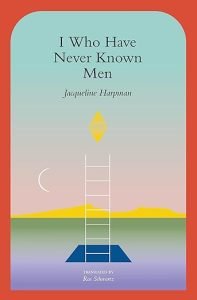
Its current popularity is due to BookTok. The edition that is out now was translated by Ros Schwartz and contains an afterword by Sophie Mackintosh, a writer who was longlisted for the Man Booker Prize.
Harpman’s book is a dystopian novel. It is the story of thirty-nine women and one pre-pubescent girl who are being held captive in an underground bunker. They are guarded by male guards who never speak to them. As the book opens, they have been in the bunker for years, indeed, the girl is now a young woman. She is also the narrator of the story.
The reader learns that the older women have vague memories of life before the bunker but almost no idea of what cataclysm befell them that led to the bunker. As for the now-young-woman, she’s a blank slate and remembers nothing of the before-world.
And then one day a siren goes off, the guards flee, and the women are able to escape the bunker. They find themselves on an immense barren plane with no other people anywhere. They don’t even know what planet they are on.
There are three “sections” of the book: in the bunker, out of the bunker, and decades later. I won’t say much about the second and third sections. The book is brief, so there is no need to spoil it. Anyone can read it for themselves.
But here are some questions to contemplate while reading it as suggested by Sophie Mackintosh in her afterword.
- Is this just a dystopian novel or a philosophical treatise instead?
- What becomes of a person when they are raised in isolation without cultural or societal constructs?
- Does the author’s personal history inform the novel? She is Jewish. When she was a child, she and her family fled Belgium and lived in exile in Casablanca during WWII.
Clocking in at only 208 pages, it’s clear to see there are lots of meaningful issues tucked into this thin volume.
*****
Click here to learn more about I Who Have Never Known Men on Amazon.

*****
I’m glad you found this book review and I hope you loved it. If so, check out my book blog – there are more than 200 reviews for you to explore, with more to come. I publish about three dozen reviews a year. Best regards, Lorie


Leave a Reply